
Bachelor of Science in Future Technology
Build intelligent software and develop future-ready digital solutions.
AI Software Development
Design intelligent systems. Build future-ready software. Lead digital innovation.
NQF Level:
7
Credits:
360
Duration:
3 Years - Full Time
Mode:
Distance, Blended or Contact Learning
Type:
Bachelor of Science
2027 Intake:
Applications Open
This three-year degree prepares you for the future of software engineering by combining programming, artificial intelligence, machine learning awareness, problem-solving, cloud-enabled development, digital innovation and workplace application.
A FUTURE-READY DEGREE FOR THE AI ERA.
This degree equips you with strong digital, analytical and software development capability, with a focused AI Software Development pathway supporting intelligent applications, automation and emerging technology careers.
What You Will Learn?
- Programming and software development fundamentals
- Application design and problem-solving
- AI concepts and intelligent systems thinking
- Data handling, analytics and algorithmic logic
- Cloud-enabled software development foundations
- Ethical, responsible and secure technology practice
- Teamwork, communication and digital professionalism
- Work-integrated learning aligned to AI software development
Career Possibilities.
Explore exciting entry-level opportunities such as:
- Junior AI Software Developer
- Software Developer
- Application Developer
- Intelligent Systems Support Analyst
- Data and Automation Support Analyst
- Junior Machine Learning Support Practitioner
- Cloud Application Support Associate
- Technology Innovation Associate
- Digital Solutions Developer
Career opportunities are indicative and subject to employer requirements.
Why Choose This Qualification?
- Innovative & relevant
- Aligned to current and emerging digital technology trends.
- Practical & applied
- Learn through projects, scenarios, coding activities and problem-solving.
- Specialised pathway
- Develop a focused AI Software Development profile within a broader Future Technology degree.
- Career & further-study ready
- Build a strong pathway into advanced study and technology careers.
What You Will Study?
The programme consists of 12 compulsory modules (360 credits)
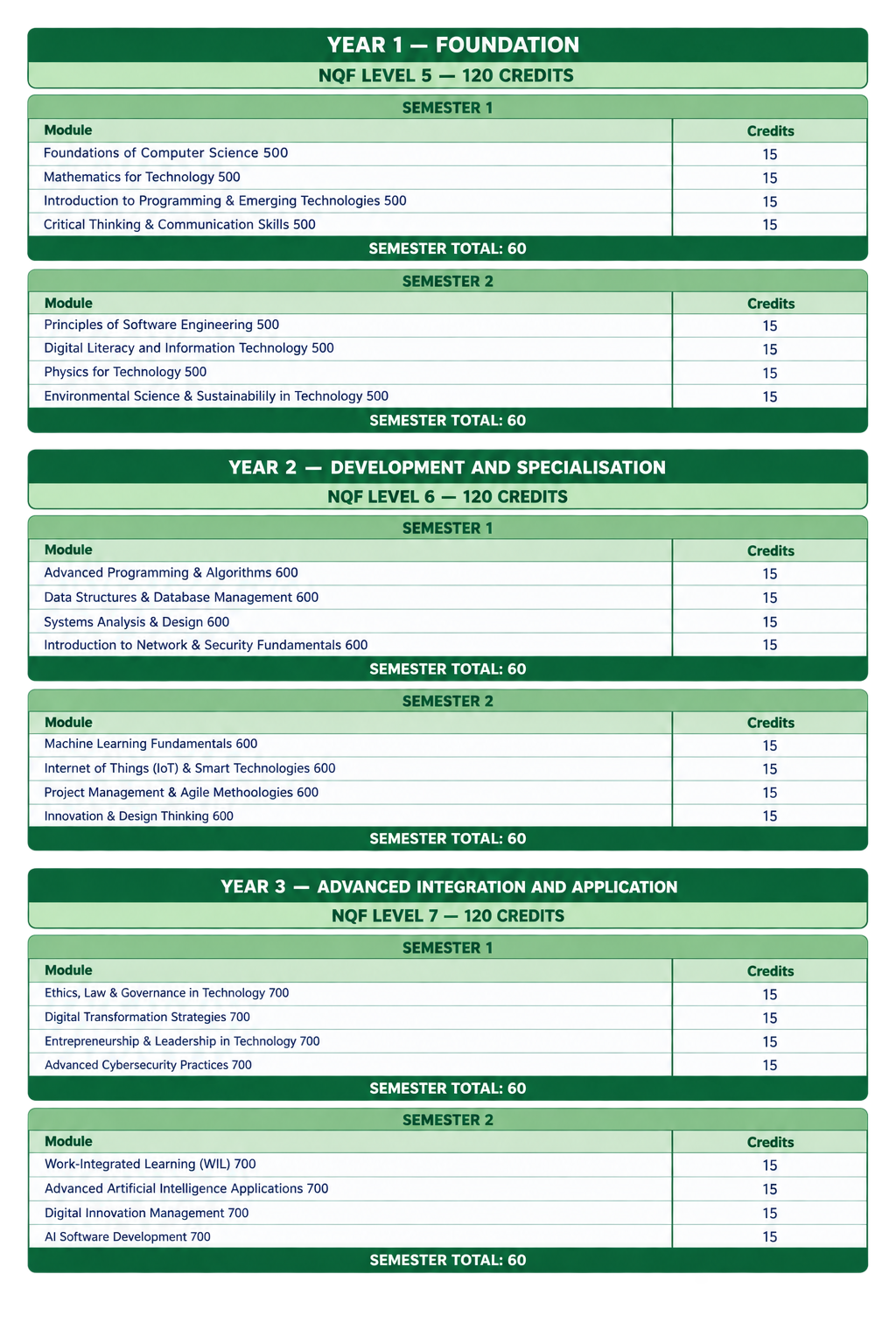
Qualification Total: 360 Credits.
All modules are compulsory. Learners must complete all four (4) modules in Semester 1 and all four (4) modules in Semester 2 each year.
How You Will Learn.
Study through AIFT’s structured Distance, Blended or Contact mode (as approved).*
- Digital learning materials
- Practical activities and technology labs
- Recorded lectures
- Online lectures & tutorials
- Projects and case studies
- Discussion & collaboration
- Lecturer & tutor support
- Independent study
Work-Integrated Learning
Practical learning may be aligned to the AI Software Development pathway through projects, workplace tasks, simulated environments, portfolio evidence, reflective learning, supervisor or facilitator feedback and professional practice.
Admission Requirements.
You may apply with one of the following:
- National Senior Certificate granting access to Bachelor's Degree studies
- National Certificate (Vocational) meeting the applicable Bachelor's Degree access requirements
- Senior Certificate with endorsement, or recognised equivalent
- Admission through Recognition of Prior Learning (RPL), where applicable
Admission is subject to AIFT's admission requirements and available programme capacity.
Minimum Digital Requirements.
- Laptop or desktop computer
- Reliable internet access
- Email address
- Webcam & headset (where required)
- Basic digital literacy
- Appropriate software tools for online learning and practical activities
Further Study Options.
You can progress to Honours or related postgraduate study in:
- Software Engineering
- Artificial Intelligence
- Information Technology
- Data Science
- Cybersecurity
- Computer Science
- Or related future technology fields
Admission to another qualification is subject to the requirements of the receiving institution.
How to Apply.
- Check admission requirements
- Prepare your documents
- Apply through an official AIFT channel
- Complete registration
Application in 4 Easy Steps.
Check admission requirements
Prepare your documents
Apply through an official AIFT channel
Complete registration and orientation
Cyber Security & Ethical Hacking
Design intelligent systems. Build future-ready software. Lead digital innovation.
NQF Level:
7
Credits:
360
Duration:
3 Years - Full Time
Mode:
Distance, Blended or Contact Learning
Type:
Bachelor of Science
2027 Intake:
Applications Open
This degree equips you with strong digital, analytical and software development capability, with a focused AI Software Development pathway supporting intelligent applications, automation and emerging technology careers.
A Future-Ready Degree for the Cyber Era.
This degree equips you with strong digital, analytical and cyber security capability, with a focused Advanced Cyber Security and Ethical Hacking pathway supporting secure systems, digital risk awareness, penetration testing and emerging technology careers.
What You Will Learn?
- Information systems and networking fundamentals
- Cyber security principles and secure systems thinking
- Threats, vulnerabilities and defensive strategies
- Ethical hacking awareness and responsible testing
- Data, networks and digital infrastructure
- Cyber law, ethics and professional conduct
- Work-Integrated Learning (WIL) experience
Career Possibilities.
- Junior Cyber Security Analyst
- Cyber Security Support Technician
- Information Security Support Analyst
- SOC Support Analyst
- Vulnerability Assessment Support Assistant
- Network Security Support Analyst
- Risk and Compliance Support Analyst
- Digital Security Operations Assistant
- Secure Systems Support Associate
Career opportunities are indicative and subject to employer requirements.
Why Choose This Qualification?
- Innovative & relevant
- Aligned to current and emerging cyber security needs.
- Practical & applied
- Learn through projects, scenarios, labs and structured problem-solving.
- Specialised pathway
- Build a focused Advanced Cyber Security and Ethical Hacking pathway.
- Career & further-study ready
- Build a strong pathway into advanced study and technology careers.
What You Will Study?
The programme consists of 12 compulsory modules (360 credits).
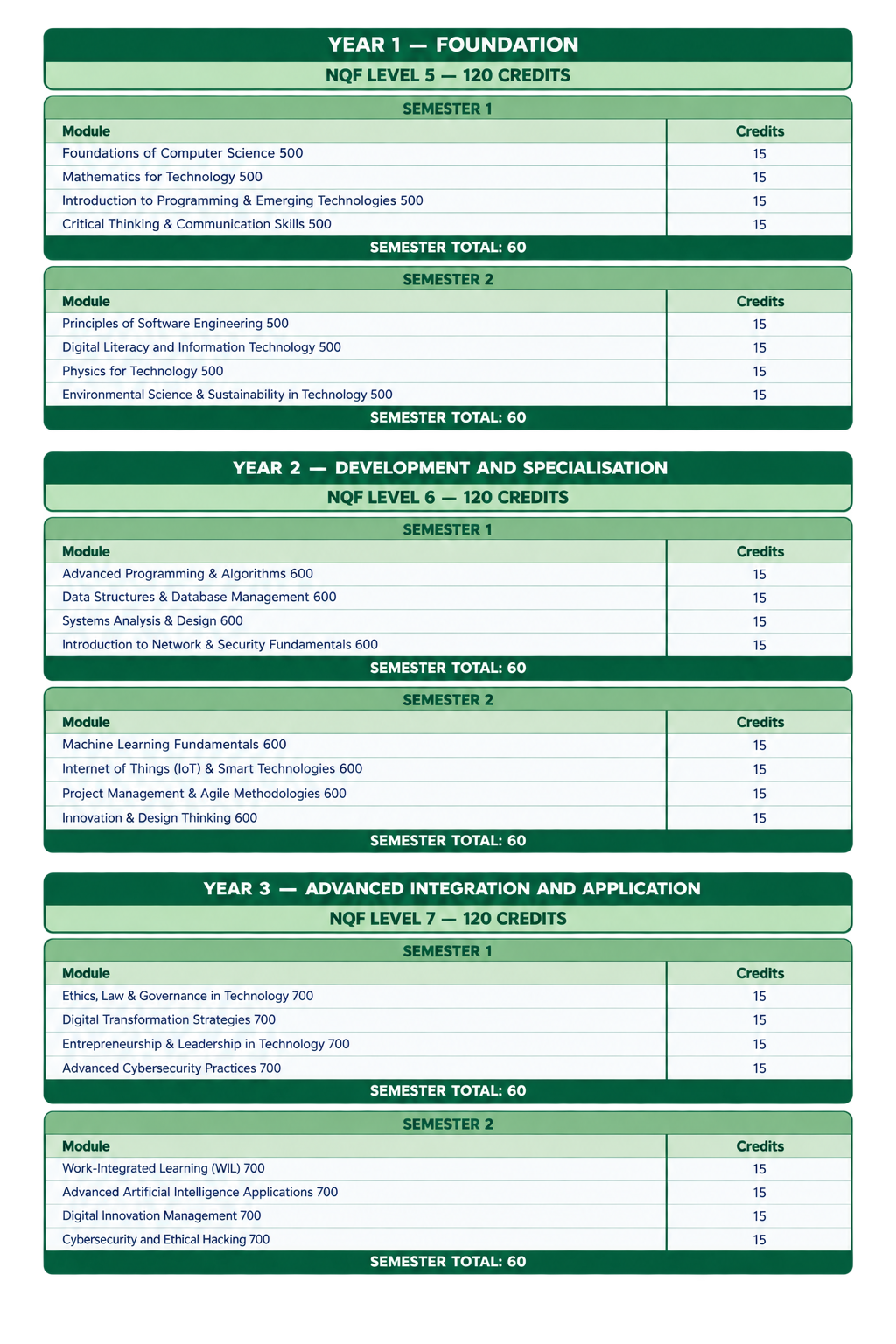
Qualification Total: 360 Credits.
All modules are compulsory. Learners must complete all four (4) modules in Semester 1 and all four (4) modules in Semester 2 each year.
How You Will Learn.
Study through AIFT’s structured Distance, Blended or Contact mode (as approved).*
- Digital learning materials
- Practical labs and activities
- Recorded lectures
- Online lectures & tutorials
- Projects and case studies
- Discussion & collaboration
- Lecturer & tutor support
- Independent study
Work-Integrated Learning
Practical learning may be aligned to the Advanced Cyber Security and Ethical Hacking pathway through projects, workplace tasks, simulated environments, portfolio evidence, reflective learning, supervisor or facilitator feedback and professional practice.
Admission Requirements.
You may apply with one of the following:
- National Senior Certificate granting access to Bachelor's Degree studies
- National Certificate (Vocational) meeting the applicable Bachelor's Degree access requirements
- Senior Certificate with endorsement, or recognised equivalent
- Admission through Recognition of Prior Learning (RPL), where applicable
Admission is subject to AIFT's admission requirements and available programme capacity.
Minimum Digital Requirements.
- Laptop or desktop computer
- Reliable internet access
- Email address
- Webcam & headset (where required)
- Basic digital literacy
- Appropriate software tools for online learning and practical activities
Further Study Options.
You can progress to Diplomas or Bachelor’s Degrees in:
- Cyber Security
- Information Technology
- Computer Science
- Information Systems
- Digital Forensics
- Network Engineering
- And other related fields
Admission to another qualification is subject to the requirements of the receiving institution.
How to Apply.
- Check admission requirements
- Prepare your documents
- Apply through an official AIFT channel
- Complete registration
Application in 4 Easy Steps.
Check admission requirements
Prepare your documents
Apply through an official AIFT channel
Complete registration and orientation
Cloud Computing & Infrastructure
Design. Deploy. Scale. Secure the Cloud.
NQF Level:
7
Credits:
360
Duration:
3 Years - Full Time
Mode:
Distance, Blended or Contact Learning
Type:
Bachelor of Science
2027 Intake:
Applications Open
Build the in-demand skills to architect, deploy and manage modern cloud solutions and enterprise infrastructure. Become a future-ready professional who powers digital transformation in every industry.
A Future-Ready Degree to a Cloud-Powered Future.
This stream develops advanced competence in cloud platforms, infrastructure, DevOps, automation, security and scalable system design — preparing you for high-impact careers in cloud engineering and infrastructure.
What You Will Learn?
- Cloud computing concepts, architectures and service models (IaaS, PaaS, SaaS)
- Cloud platforms (AWS, Microsoft Azure, Google Cloud)
- Virtualisation, containers and orchestration (Docker, Kubernetes)
- Network architecture and cloud connectivity
- Infrastructure as Code (IaC) and automation
- DevOps practices and CI/CD pipelines
- Cloud security, identity and compliance
- Monitoring, logging and cost management
- Disaster recovery, business continuity and high availability
- Work-Integrated Learning in cloud and infrastructure environments
Career Possibilities.
JExplore exciting roles in the cloud and infrastructure ecosystem:
- Cloud Engineer
- Cloud Infrastructure Engineer
- DevOps Engineer
- Site Reliability Engineer (SRE)
- Systems Administrator
- Cloud Solutions Architect (Junior)
- Network Engineer (Cloud Focus)
- Cloud Security Analyst
- IT Operations Engineer
- Technical Consultant (Cloud)
Career opportunities are indicative and subject to employer requirements.
Why Choose This Qualification?
- INDUSTRY-RELEVANT CURRICULUM
Aligned to global cloud platforms, tools and best practices. - HANDS-ON & PRACTICAL
Learn in labs, simulations and real-world cloud projects. - FUTURE-FOCUSED SKILLS
Cloud computing and infrastructure skills are among the most in-demand worldwide. - STRONG CAREER OUTLOOK
Excellent employability and growth potential across all industries. - PATHWAY TO FURTHER STUDY
Progress to Honours and postgraduate qualifications in technology and beyond.
What You Will Study?
The programme consists of 24 modules (360 credits).
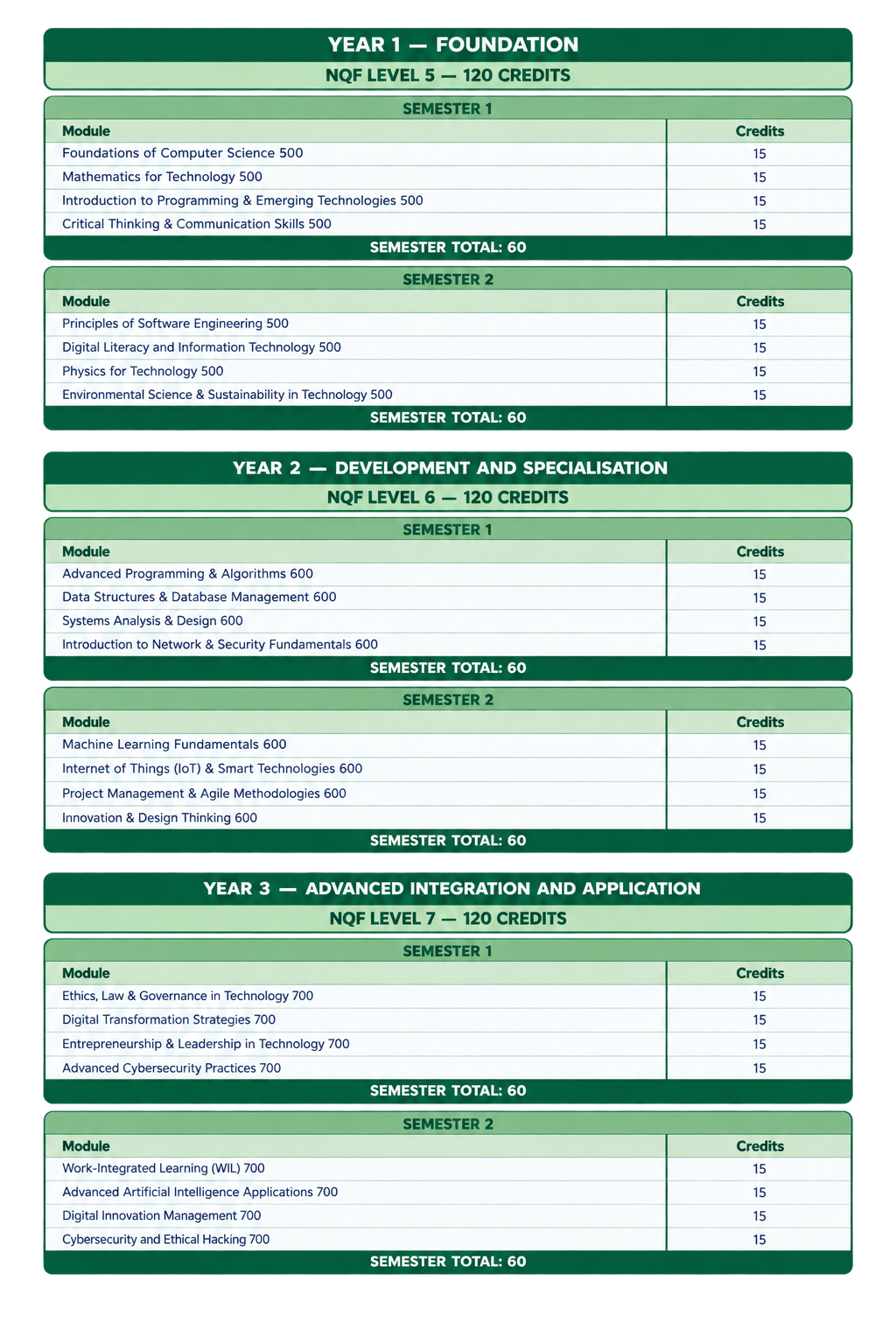
Qualification Total: 360 Credits.
All modules are compulsory. Learners must complete all four (4) modules in Semester 1 and all four (4) modules in Semester 2 each year.
How You Will Learn.
Study through AIFT’s structured Distance, Blended or Contact mode (as approved).*
- Digital learning materials
- Practical labs and activities
- Recorded lectures
- Online lectures & tutorials
- Projects and case studies
- Discussion & collaboration
- Lecturer & tutor support
- Independent study
Work-Integrated Learning
Gain real-world experience in cloud and infrastructure roles. Apply your learning in an approved workplace or project environment.
- Industry Placement
- Live Cloud Projects
- Professional Mentorship
- Portfolio of Evidence
- Career Readiness
Admission Requirements.
You may apply with one of the following:
- National Senior Certificate granting access to Bachelor's Degree studies
- National Certificate (Vocational) meeting the applicable Bachelor's Degree access requirements
- Senior Certificate with endorsement, or recognised equivalent
- Admission through Recognition of Prior Learning (RPL), where applicable
Admission is subject to AIFT's admission requirements and available programme capacity.
Minimum Digital Requirements.
- Laptop or desktop computer
- Reliable internet access
- Email address
- Webcam & headset (where required)
- Basic digital literacy
- Appropriate software tools for online learning and practical activities
Further Study Options.
You can progress to:
- Honours in Information Technology / Computer Science / Engineering
- Postgraduate Diplomas
- Master's Degrees in Cloud Computing, Information Technology, Cybersecurity, Data Science and more
Admission to another qualification is subject to the requirements of the receiving institution.
How to Apply.
- Check admission requirements
- Prepare your documents
- Apply through an official AIFT channel
- Complete registration
Application in 4 Easy Steps.
Check admission requirements
Prepare your documents
Apply through an official AIFT channel
Complete registration and orientation
Predictive Data Analytics
Turn data into insight. Predict trends. Drive better decisions.
NQF Level:
7
Credits:
360
Duration:
3 Years - Full Time
Mode:
Distance, Blended or Contact Learning
Type:
Bachelor of Science
2027 Intake:
Applications Open
This three-year, future-focused degree pathway prepares you for data-driven careers by combining digital and ICT foundations, data analysis, predictive modelling awareness, statistical thinking, visualisation, problem-solving and workplace application.
A Future-Ready Degree to a Data Driven-Future.
This stream develops competence in data analysis, decision making, data interpretation, visualisation, pattern recognition and analytical decision support within the broader Future Technology degree.
What You Will Learn?
- Digital and ICT foundations
- Data analysis and interpretation
- Statistics and quantitative reasoning
- Predictive data analytics awareness
- Data visualisation and dashboard thinking
- Problem-solving using data-driven approaches
- Responsible and ethical data practice
- Communication, teamwork and digital professionalism
- Work-Integrated Learning aligned to the data analytics pathway
Career Possibilities.
Explore exciting roles in the cloud and infrastructure ecosystem:
- Junior Data Analyst
- Predictive Analytics Support Associate
- Business Intelligence Support Analyst
- Data Visualisation Assistant
- Reporting and Insights Assistant
- Data Quality Support Practitioner
- Information Analyst Support Associate
- Digital Insights Associate
- Analytics Operations Support Assistant
Career opportunities are indicative and subject to employer requirements.
Why Choose This Qualification?
- INDUSTRY-RELEVANT AND FUTURE-FOCUSED
Built for the growing demand for data analytics skills across all sectors.
- PRACTICAL AND APPLIED LEARNING
Hands-on projects, tools and real-world scenarios to build confidence.
- STRONG ANAL YTICAL FOUNDATION
Develop core statistical thinking, logic and problem-solving.
- CAREER AND FURTHER-STUDY READY
Prepare for employment or postgraduate study in data and technology fields.
- DATA-DRIVEN DECISION-MAKING CAPABILITY
Learn to turn data into insights that inform better decisions.
What You Will Study?
The programme consists of 24 modules (360 credits).
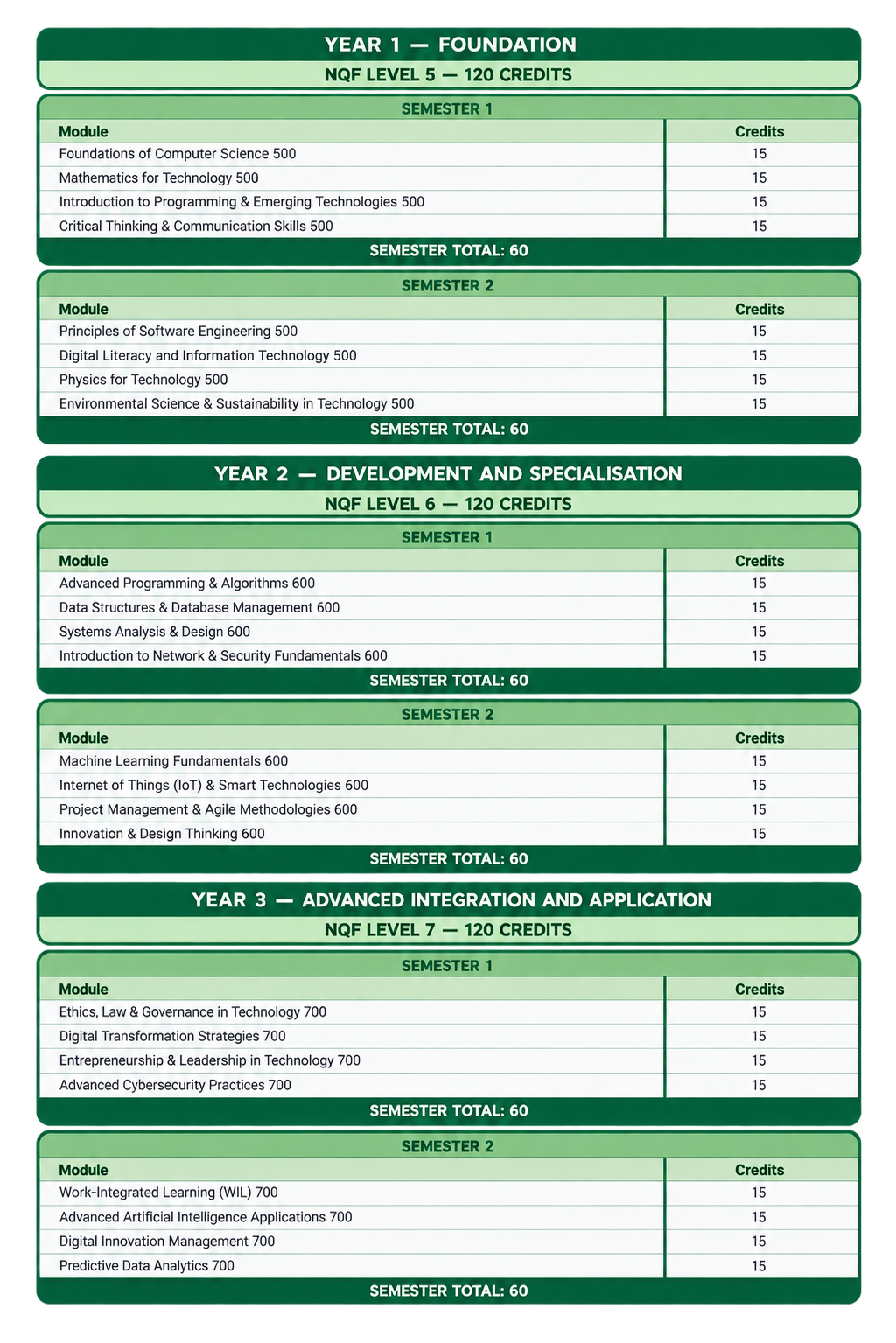
Qualification Total: 360 Credits.
How You Will Learn.
- Digital learning materials
- Practical activities and technology labs
- Recorded lectures
- Online lectures & tutorials
- Projects and case studies
- Discussion & collaboration
- Lecturer & tutor support
- Independent study
Work-Integrated Learning
Practical learning may be aligned to the Predictive Data Analytics pathway through projects, workplace tasks, simulated environments, portfolio evidence, reflective learning, supervisor or facilitator feedback and professional practice.
Admission Requirements.
You may apply with one of the following:
- National Senior Certificate granting access to Bachelor's Degree studies
- National Certificate (Vocational) meeting the applicable Bachelor's Degree access requirements
- Senior Certificate with endorsement, or recognised equivalent
- Admission through Recognition of Prior Learning (RPL), where applicable
Admission is subject to AIFT's admission requirements and available programme capacity.
Minimum Digital Requirements.
- Laptop or desktop computer
- Reliable internet access
- Email address
- Webcam & headset (where required)
- Basic digital literacy
- Appropriate software tools for online learning and practical activities
Further Study Options.
Progress to honours or related postgraduate study in data analytics, information technology, artificial intelligence, business intelligence, digital innovation or other related disciplines at AIFT or other recognised institutions.
How to Apply.
- Check admission requirements
- Prepare your documents
- Apply through an official AIFT channel
- Complete registration
Application in 4 Easy Steps.
Check admission requirements
Prepare your documents
Apply through an official AIFT channel
Complete registration and orientation
Blockchain Technologies
Build trust. Secure transactions. Shape the decentralised future..
NQF Level:
7
Credits:
360
Duration:
3 Years - Full Time
Mode:
Distance, Blended or Contact Learning
Type:
Bachelor of Science
2027 Intake:
Applications Open
This three-year degree pathway prepares you for emerging blockchain and distributed technology environments by combining digital and ICT foundations, blockchain concepts, secure digital transactions, decentralised systems awareness, problem-solving and workplace application.
A Future-Ready Degree to Decentralised Digital Innovation.
This stream develops foundational and applied capability in blockchain technologies, distributed systems, smart contracts, digital trust and emerging decentralised applications within the broader Bachelor of Science in Future Technology.
What You Will Learn?
- Blockchain fundamentals and architecture
- Smart contracts and dApps
- Cryptography and digital security
- Consensus mechanisms and network operations
- Blockchain platforms and tools
- Digital assets and tokenisation
- Real-world blockchain use cases
- Ethics, governance and regulation
Career Possibilities.
- Blockchain Developer
- Smart Contract Developer
- Blockchain Solutions Analyst
- Distributed Ledger Technology Analyst
- Blockchain Application Developer
- Web3 / Decentralised Application Developer
- Blockchain Security Analyst
- Blockchain Technology Consultant
Career opportunities are indicative and subject to employer requirements.
Why Choose This Qualification?
- HIGH-DEMAND FUTURE SKILLS
Be at the forefront of trusted digital solutions and Web3 innovation.
- HANDS-ON LEARNING
Work with real blockchain platforms, tools and projects.
- STRONG INDUSTRY RELEVANCE
Prepare for careers in fintech, blockchain development, digital assets and decentralised systems.
- FUTURE-READY
Build capability in a fast-growing, globally relevant technology.
What You Will Study?
The programme consists of 24 modules (360 credits).
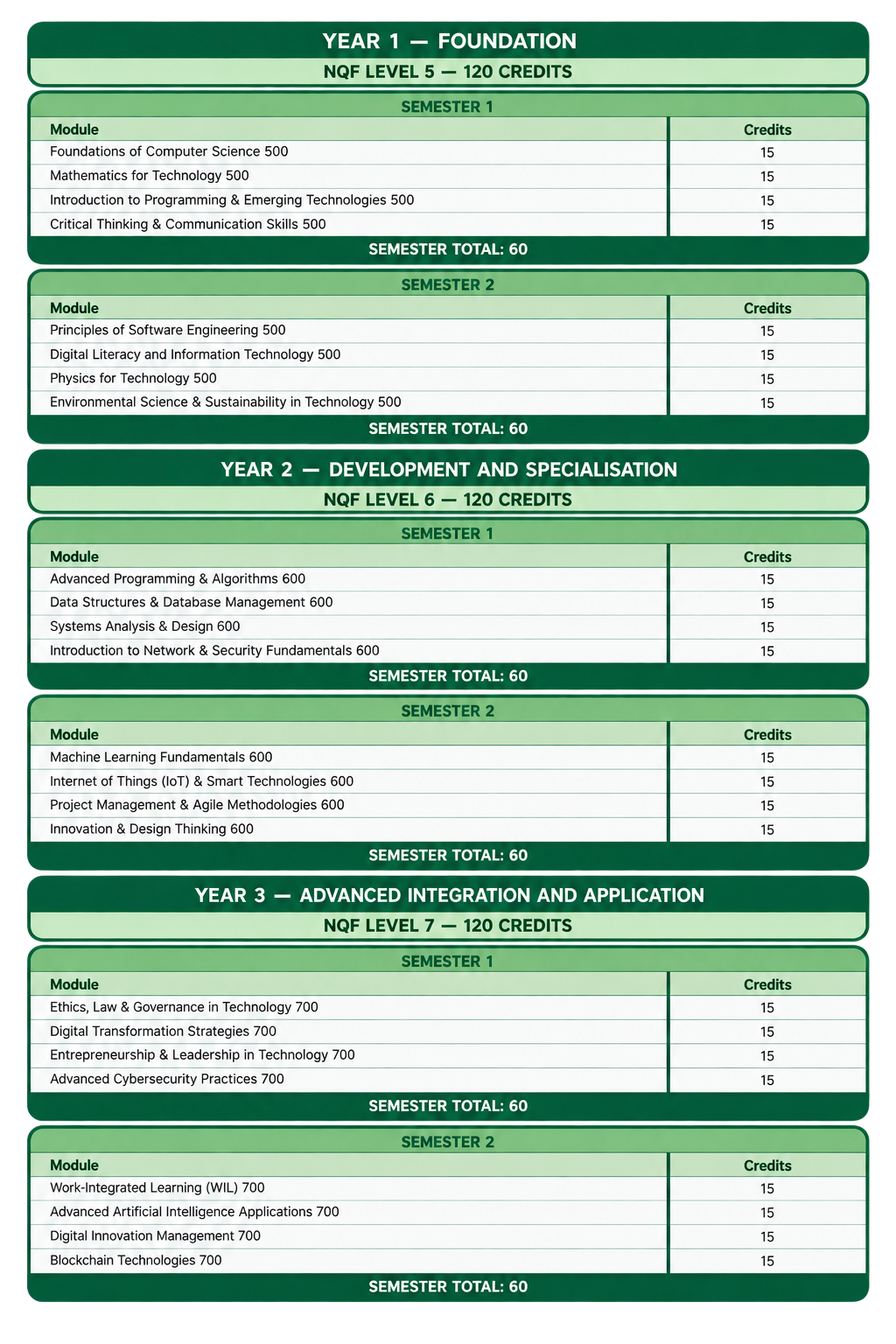
Qualification Total: 360 Credits.
How You Will Learn.
- Digital learning materials
- Practical activities and technology labs
- Recorded lectures
- Online lectures & tutorials
- Projects and case studies
- Discussion & collaboration
- Lecturer & tutor support
- Independent study
Work-Integrated Learning (Stream-Aligned)
Practical learning may be aligned to the Predictive Data Analytics pathway through projects, workplace tasks, simulated environments, portfolio evidence, reflective learning, supervisor or facilitator feedback and professional practice.
Admission Requirements.
- National Senior Certificate (NSC) with Bachelor’s degree endorsement or recognised equivalent
- Achievement in Mathematics
- Bridging programme may be required
Minimum Digital Requirements.
- Laptop or desktop computer
- Reliable internet access
- Email address
- Webcam & headset (where required)
- Basic digital literacy
- Appropriate software tools for online learning and practical activities
Further Study Options.
Progress to honours or related postgraduate study in blockchain technologies, information technology, computer science, cybersecurity, financial technology, digital innovation or other related disciplines at AIFT or other recognised institutions, subject to programme availability and admission requirements.
How to Apply.
- Check admission requirements
- Prepare your documents
- Apply through an official AIFT channel
- Complete registration
Application in 4 Easy Steps.
Check admission requirements
Prepare your documents
Apply through an official AIFT channel
Complete registration and orientation