Higher Occupational Certificate:
Artificial Intelligence Software Developer
Code Intelligence. Build the Future.
Develop in-demand skills to build, train, deploy and maintain AI solutions. Turn data into intelligent applications that solve real-world problems.
SAQA Qual ID:
118792
Qualification Title:
Occupational Certificate: Artificial Intelligence Software Developer
NQF Sub-Framework:
OQSF - Occupational Qualifications Sub-framework
Originator:
Development Quality Partner - MICT SETA
Primary or Delegated Quality Assurance Functionary:
MICT SETA
Qualification Type
Occupational Certificate
Minimum Credits
209
NQF Level
NQF Level 05
Build Intelligent Solutions That Shape Tomorrow.
AI Software Developers Create, Train and Deploy AI Models and Integrate Them Into Real-World Applications. Be Part of the Innovation Driving Industries Forward.
- Solve Real-World Problems
- Train Models With Accuracy
- Deploy & Maintain AI Systems
- Drive Digital Transformation
What You Will Learn?
- Mathematics, statistics and analytical thinking
- Data management, databases and visualisation
- Programming in Python for AI development
- Machine learning and deep learning concepts
- Build and train AI models with real data
- Test, evaluate and optimise AI models
- Deploy and maintain AI solutions
- Ethics, governance and responsible AI
- Work-Integrated Learning (WIL)
Career Possibilities.
Explore exciting roles such as:
- AI Software Developer
- Machine Learning Developer
- AI Research Assistant
- Data Scientist Associate
- Junior AI Engineer
- AI Solutions Analyst
- Computer Vision Analyst
- Deep Learning Developer
- Robotics Software Developer
- Business Intelligence Developer
Career opportunities are indicative and subject to individual capability and employer requirements.
Why Choose This Qualification?
IN-DEMAND SKILLS
AI professionals are among the most sought-after globally.
HANDS-ON & PRACTICAL
Learn through labs, projects and real-world AI scenarios.
INDUSTRY-RELEVANT
Curriculum developed with industry input and aligned to current technologies.
STRONG CAREER OUTLOOK
High growth field with excellent local and global opportunities.
PATHWAY TO ADVANCEMENT
Articulate to Diplomas and Degrees in ICT and related fields.
What You Will Study?
The programme consists of 26 modules (209 credits).
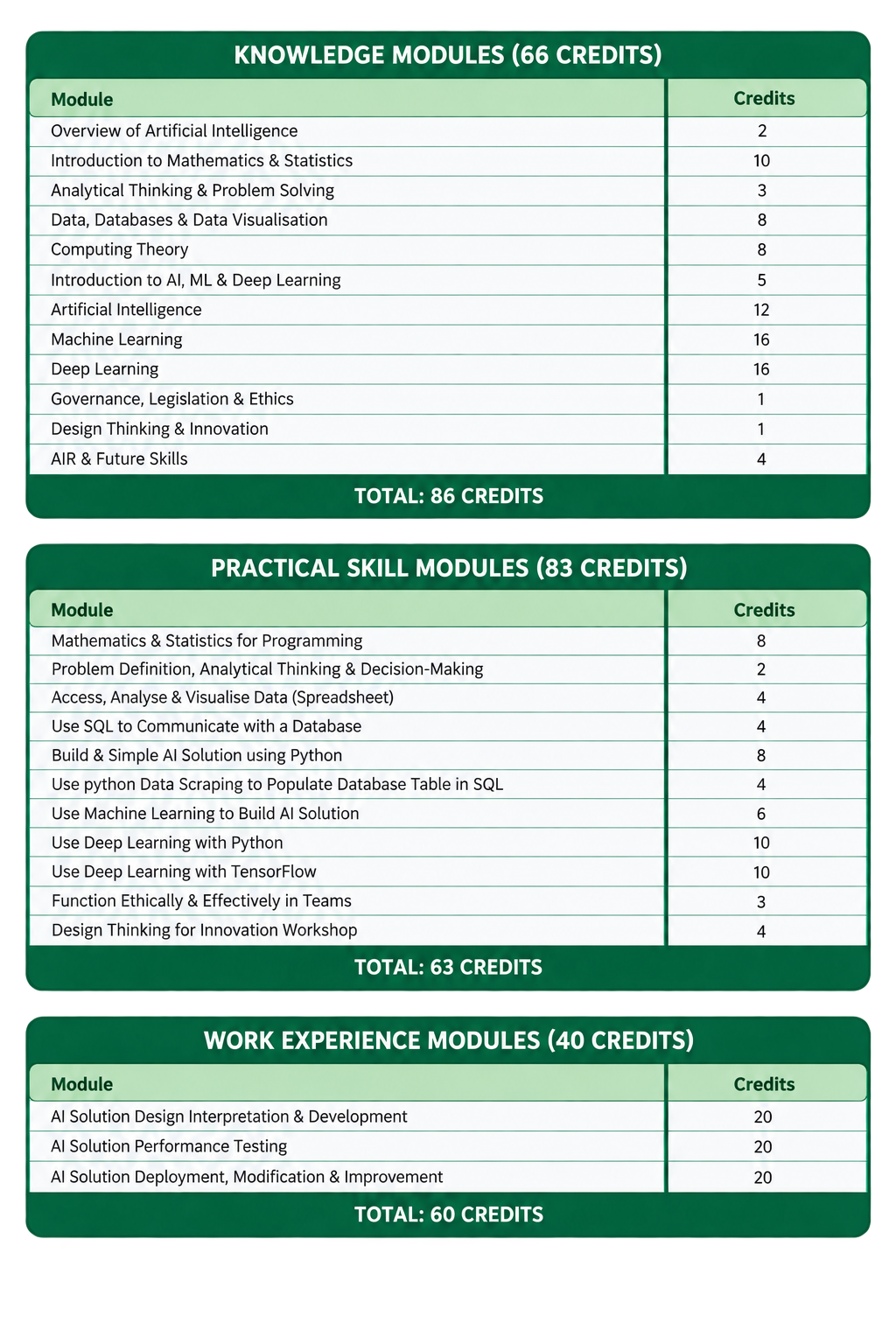
Total Qualification Credits: 209.
All modules are compulsory. Learners must complete all four (4) modules in Semester 1 and all four (4) modules in Semester 2 each year.
How You Will Learn.
Study through AIFT's Contact or Distance mode.
- Digital learning materials
- Labs & practical exercises
- Recorded lectures
- Online lectures & tutorials
- Case studies & projects
- Discussion & collaboration
- Lecturer & tutor support
- Industry project exposure
- Independent study
Admission Requirements.
You may apply with one of the following:
- NQF Level 4 qualification (minimum requirement)
- National Senior Certificate (Grade 12)
- Recognition of Prior Learning (RPL)
Admission is subject to AIFT's admissions requirements, supporting documentation and available capacity.
Minimum Requirements.
- Laptop or desktop computer
- Reliable internet access
- Email address
- Webcam & headset (where required)
- Basic digital literacy
- Microsoft Office or compatible software
Further Study Options.
You can progress to Honours or related postgraduate study in:
- Software Engineering
- Artificial Intelligence
- Information Technology
- Data Science
- Cybersecurity
- Computer Science
- Or related future technology fields
Admission to another qualification is subject to the requirements of the receiving institution.
How to Apply.
- Check admission requirements
- Prepare your documents
- Apply through an official AIFT channel
- Complete registration
Application in 4 Easy Steps.
- Check admission requirements
- Prepare your documents
- Apply through an official AIFT channel
- Complete registration and orientation